Two thoughts about film photography
Roland Barthes probably wouldn't have cared about the "film simulation" in the brand new Fuji X100VI, but I'm not him
Honesty
I recently found this video where the author talks about choosing honest materials in interior design. I found it to be a good analogy to borrow and discuss about what it means to replicate the “look and feel” of film photography.
Let’s talk about hardwood floors.
You have many different material options if you’re remodelling or designing a room: concrete, tiles, stones, hardwood… and “engineered materials”, such as hardwood veneers stuck on MDF, or vinyl stick-on tiles, that can look like any of the materials I just listed. You can buy veneered or vinyl flooring of virtually any material, at any price point. You can find really well made vinyl panels that definitely look like hardwood.
By doing this, you’ll get the look of hardwood floors, but not the feel of it. You can take a picture of your living room, where the floor will look like hardwood floors, but any visiting guests should be able tell it’s not real hardwood, because it doesn’t feel like it. The way it creaks or squeaks when you walk on it, the way some patterns repeat or the way it reflects the light are some of the clues they might pick.
If this makes sense, then you understand how I feel about “making photos look like film” (I’m putting filters, presets, recipes, emulations and simulations all in the same bag here. Even shooting jpeg instead of raw ‘on purpose’ counts, if the intention is to output a ‘lower quality’ image in order to reproduce a film look).
If I ask “why don’t you just shoot film?”, the answers I am able to gather here and there tell me that it’s “the aesthetics”, that it’s cool, that the vibes are just right, that film is just too expensive, that it makes pictures more interesting by “adding nostalgia” to them. I get all of that, but I have so many more questions (like “can one genuinely manufacture nostalgia?”).
My point is that film has the honesty of real hardwood floors, that any attempt at replicating it might never have. Film photography is often described as pretentious, but when bypassing aesthetics and authenticity (which are completely separate discussions) and dissecting it through the definition of honesty, I don’t think it fits the definition anymore. It doesn’t pretend to be something it’s not. On the other hand, I can only see reproducing the film look as dishonest, regardless of how it’s done.
You can shoot and edit film pictures any way you want, but in that case, you’re editing a film picture, not trying to make a picture look and feel like film. You’ve committed to a film stock, the light was “what it was” at this exact instant, and the camera captured the subject in front of you, at this moment. You’re not pretending to use film, you actually used it.
Reproducing the film look is similar to putting a lot of effort into crafting, then using the most hyperrealistic hardwood vinyl panel ever, in an attempt to get as close as possible to something that actually exists, and that is available. The absolute best reproduction could get close in terms of feel, but will only ever be a reproduction.
In the end, I guess that’s fine, as long as you are aware of the fact that you are only reproducing the look of it. It might start becoming an issue if you believe (or try to get others to believe that) you are recreating the look and feel of it.
[…] La Couleur est pour moi un postiche, un fard (tel celui dont on peint les cadavres). Car ce qui m’importe, ce n’est pas la “vie” de la photo (notion purement idéologique), mais la certitude que le corps photographié vient me toucher de ses propres rayons, et non d’une lumière surajoutée.[…]
Roland Barthes, La chambre claire, p. 127
Friction
When compared to what “modern” digital photography offers in terms of editing, film is objectively of a lower quality in virtually any dimension, like resolution, sharpness, dynamic range, detail preservation, low light performance and all other pure technical properties. Digital just captures more and better quality information, and makes any edits or alterations much easier. I sometimes think of digital cameras as computers that can literally see in the dark, and editing as playing with invisible light.
“I’ll fix it in post” is not a sentence you’ll hear out loud very often, but I think the idea is definitely out there, as soon as you leave the realm of “casual” photography. Anybody dipping their toes into photography as an artistic practice probably goes through this at some point, likely early in the discovery journey of the hobby. With enough time, sweat, tears a skill, you discover that you can basically turn any “bad” picture into a “good” one. That’s the magic of editing.
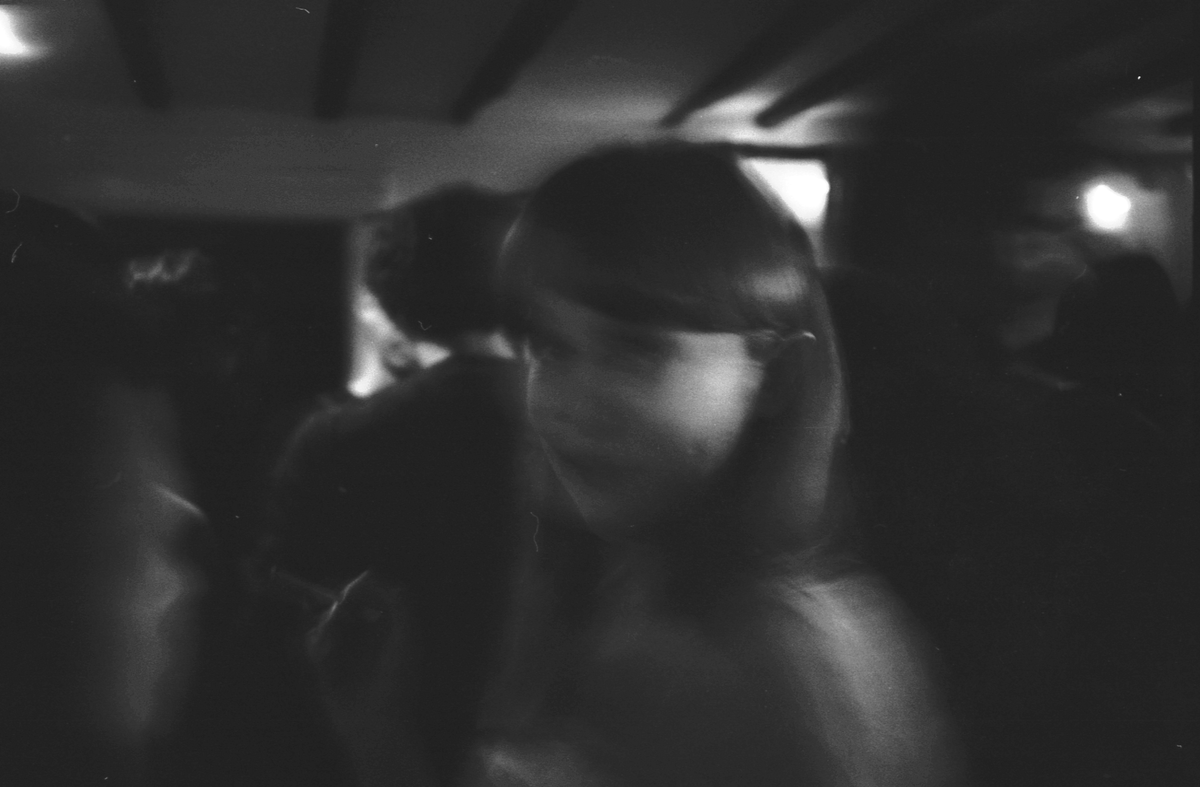
I spent my fair share of time in editing tools, but I never enjoyed the process. It has always felt like I’m diluting the picture by trying to save it, but I’m also probably just really bad at editing. The image you can see below has more flaws than redeeming qualities, technically speaking. It can definitely be labelled as ‘lucky’ or ‘accidental’, but despite that, I don’t think it needs any editing. That’s what I was able to capture, that’s what was there, in front of my camera. I don’t see any point in me trying to “save” this picture.
[…] L’effet qu’elle produit sur moi n’est pas de restituer ce qui est aboli (par le temps, la distance), mais d’attester que cela que je vois, a bien été. […]
Roland Barthes, La chambre claire, p. 128
I sometimes feel that digital photography stole and changed the definition of what ‘raw’ means. In this context, raw means things like ‘flat’, ‘very minimally processed data’ or ‘straight from the sensor’. The initial data might be raw, but there’s a very loud expectation behind it: the data will be processed, because a flexible workflow is entire point of shooting digital raw. Processing and editing is an integral stage of the photography production experience, but I just happen to think about it as friction, or as added substance to your source material.
In comparison, I see shooting film as inherently raw, in the way we describe things other than photography as raw. Raw food, raw emotions, raw materials. With little to no transformation or processing between “what was there” and “what I’m showing you”. You only get to see the light that was there at the exact moment the shutter was pressed, and not a light I made up in the editing process. And in that sense, film is to me “more raw” than digital raw itself.

Sources:
- “La chambre claire” by Roland Barthes was originally published in 1980, and translated in 1981, as “Camera Lucida”. I’m glad I can enjoy this essay in its original language, as the translated version seems like a very difficult read
- “We need to talk about your ‘faux’ materials” by Noah Daniel (youtube)
- “Fujifilm X-Pro3 - A Film Photographer's Perspective” by Pushing Film (youtube): recommended if you’re not familiar with the topic of in-camera film simulations
Bonus: I answered a few questions about my book on The Practical Polymath last week, go check it out!